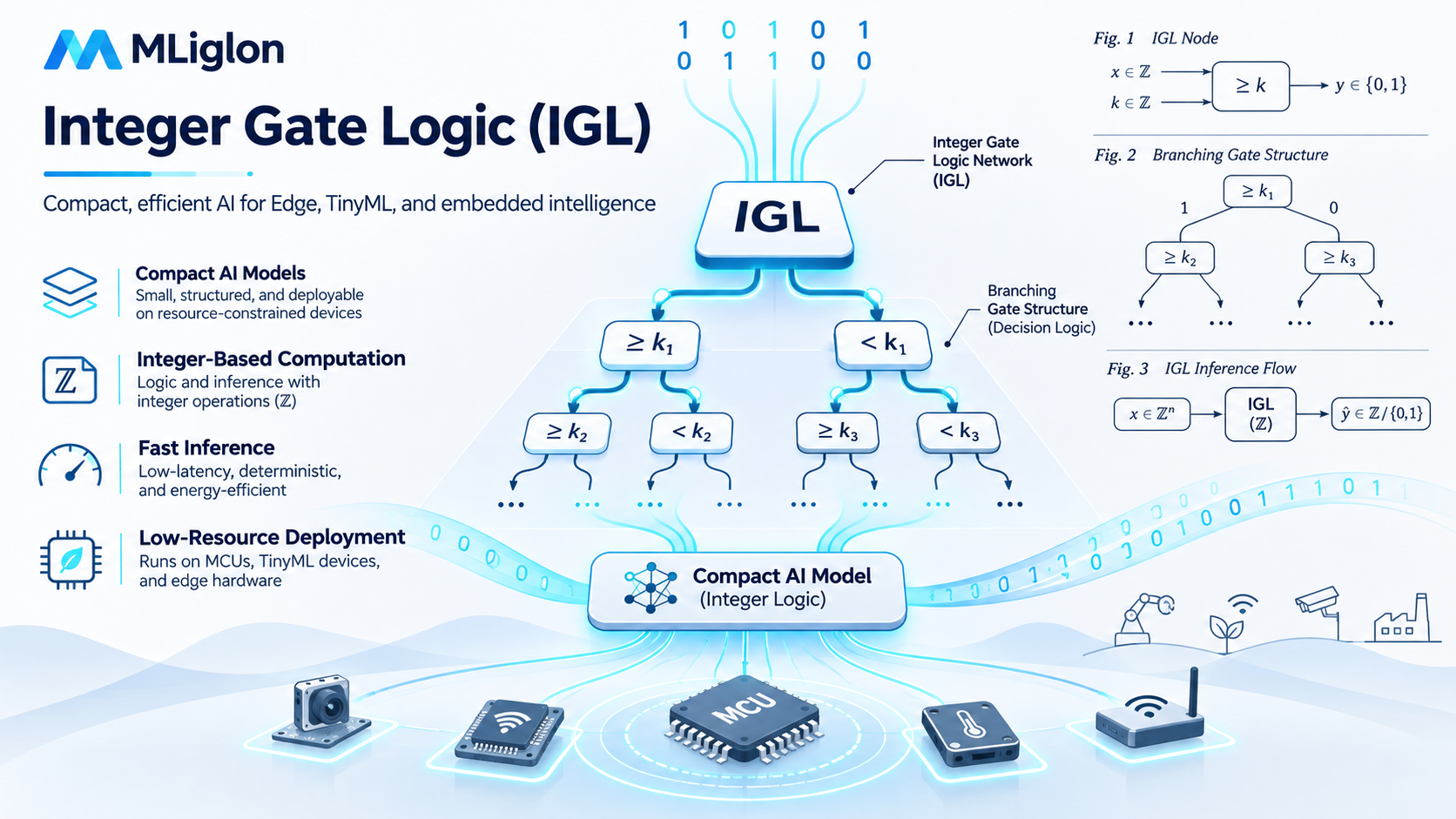
Integer Gate Logic (IGL): A New Approach to Artificial Intelligence
Integer Gate Logic (IGL) is an innovative, patented artificial intelligence technology developed by MLiglon Corporation. Designed as an alternative to conventional neural networks, IGL uses compact networks of integer-based computational elements to perform machine learning, classification, and pattern recognition with exceptional computational efficiency.
Unlike traditional deep learning systems that rely heavily on floating-point arithmetic and backpropagation, IGL employs discrete, integer-based operations and specialized learning methods. This architecture offers the potential to dramatically reduce model size, memory requirements, computational complexity, and energy consumption while maintaining highly competitive prediction accuracy.
Experimental evaluations across image recognition, natural language processing, and speech recognition have demonstrated promising results. In selected benchmarks, IGL models have achieved accuracy comparable to conventional neural networks while requiring substantially less parameter storage and faster inference.
IGL is particularly promising for Edge AI, TinyML, embedded systems, robotics, intelligent sensors, and Internet of Things (IoT) applications, where processing power, memory, and energy are limited.
Through continued research, patented innovations, and advanced implementations such as convolutional IGL architectures, MLiglon is developing a new generation of efficient artificial intelligence technologies designed to bring powerful machine learning capabilities to smaller, faster, and more energy-efficient computing platforms.
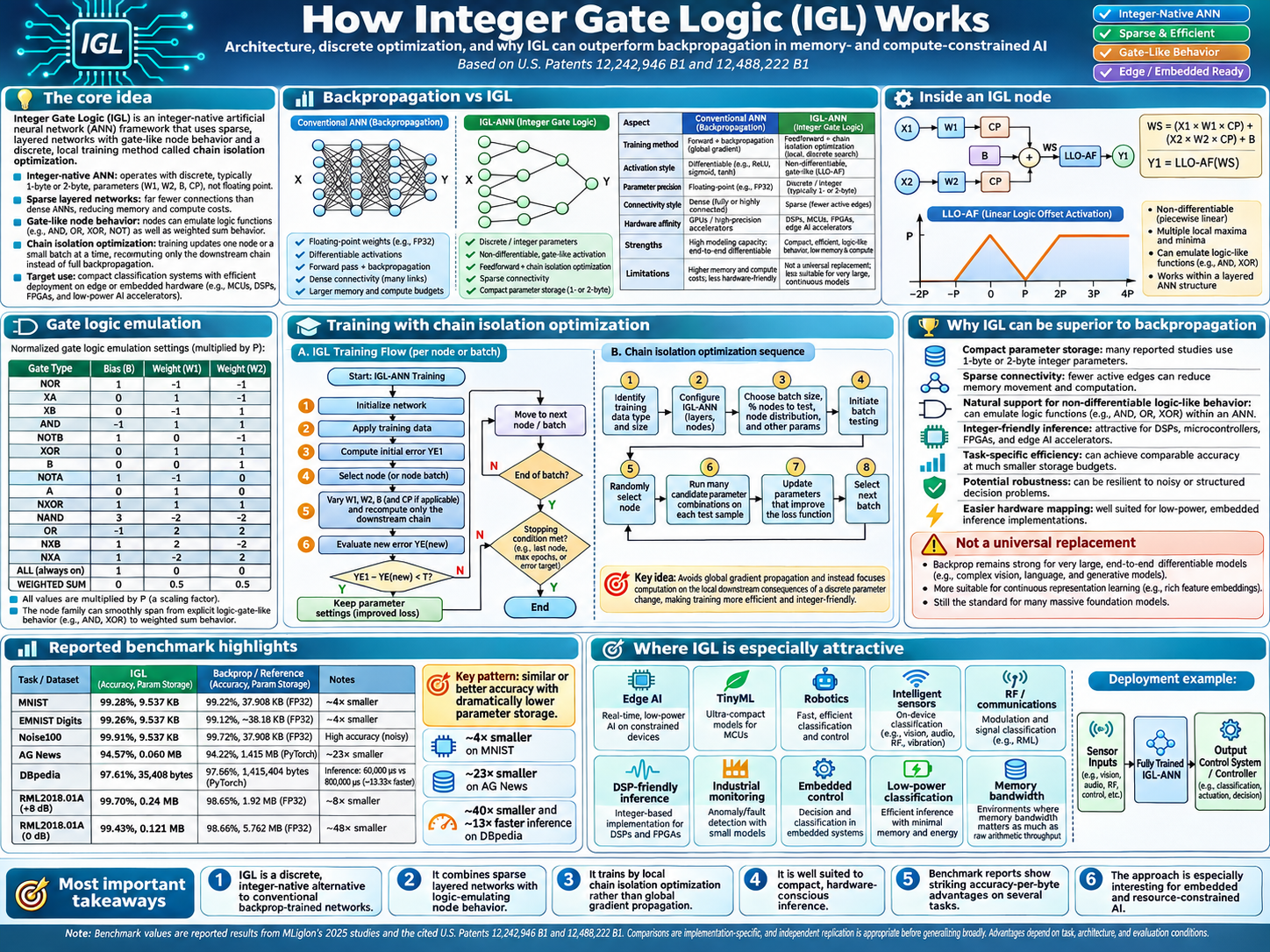
How Integer Gate Logic Works: A Different Approach to Artificial Neural Networks
MLiglon Corporation’s patented Integer Gate Logic (IGL) architecture introduces an alternative approach to artificial intelligence using compact integer-valued parameters, specialized nonlinear activation functions, and discrete optimization methods that do not require conventional gradient backpropagation.
At the core of IGL is a computational node that combines weighted inputs and a bias, then processes the result through a non-monotonic, piecewise-linear activation function. Unlike conventional neurons using monotonic activations, an individual IGL node can reproduce Boolean logic functions such as AND, OR, XOR, XNOR, NAND, and NOR simply by changing its weights and bias. Intermediate activation values also allow nodes to express graded nonlinear relationships beyond strictly binary logic.
IGL networks learn through chain isolation optimization, which evaluates candidate integer parameter changes and measures their effects on prediction error. By reusing previously calculated outputs from unaffected nodes and recalculating only the relevant downstream dependencies, this methodology offers opportunities to reduce redundant computation and parallelize training across CPUs and GPUs.
The architecture’s use of INT8 and INT16 parameters, integer arithmetic, configurable connectivity, and potentially lookup-table-based activation makes it particularly interesting for compact machine-learning models and deployment on microcontrollers, DSPs, TinyML devices, and Edge AI systems.
Together, these features provide a foundation for investigating parameter-efficient neural networks, alternative training algorithms, and hardware-oriented artificial intelligence, with reported benchmark studies demonstrating competitive classification accuracy using substantially smaller parameter representations than selected conventional FP32 baselines.
Technical note: IGL’s architectural and computational advantages depend on the application, network configuration, optimization strategy, and target hardware. Reduced parameter storage does not necessarily imply proportional reductions in runtime memory, execution time, or energy consumption. Comparative performance should be established through controlled benchmarking.